The Takeoff The decking line
Get the decking rate in writing, or pay for it on the day
Everything else on a takeoff can be measured before the job. The wood under your shingles cannot, which is exactly why its unit rate belongs on the document before anyone starts. It is the most common reason a real number moves, and it moves at the moment you have the least leverage in the whole job.
The line most likely to change your final invoice is the one nobody can see today. The decking, or sheathing, is the structural surface the shingles are fastened to. On a house built in the last sixty years or so it is usually plywood or oriented strand board in four by eight sheets. On older St. Louis housing stock it is very often plank decking: individual sawn boards laid across the rafters with gaps between them.
Nobody can see it. Not the salesperson at your table, not the aerial imagery, not you. It is under an inch of asphalt and felt and it stays there until the morning the tear off happens, at which point everybody finds out together.
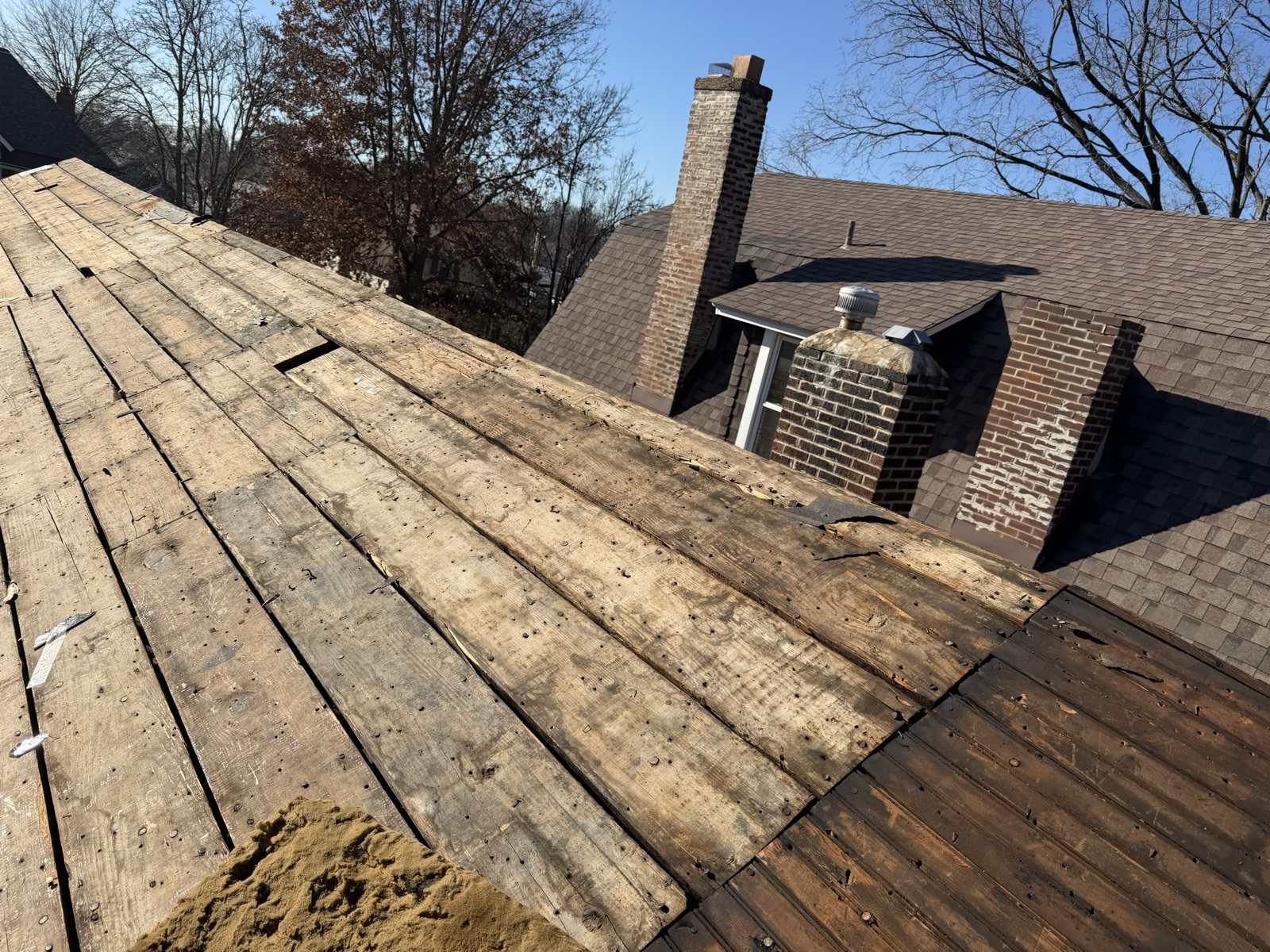
What actually gets replaced, and why
- Rot. A leak that was ignored, or a valley that has been wet for years, turns wood soft. It will not hold a nail and it has to come out.
- Delamination. Plywood and strand board come apart in layers when they have been repeatedly wet. The surface looks intact and crumbles when a fastener goes in.
- Split boards. Plank decking splits along the grain around old nail holes, and a board that has been nailed through four times over a century has very little integrity left.
- Gaps too wide to fasten. Plank decking shrinks. If the gap between boards is wide enough that nails land in air, the plane has to be sheeted over or the boards replaced.
- Old penetrations. Where a vent, a swamp cooler or an aerial mast used to be, there is a hole with a patch over it that may or may not be sound.
The number that belongs on the estimate before the work starts
Not the total, and not an allowance buried in a paragraph. A unit price. Something of the form: replacement sheathing charged per sheet of a stated size and thickness, or per linear foot of board, at a rate written on the document you signed, with the count photographed as the work happens.
This single line does more to protect a homeowner than anything else on a roofing contract. It converts an open ended surprise into a quantity times a rate that was agreed while you still had every other option available to you. If a company will not put a unit price in writing, the reason is almost always that they would rather establish the rate on the day, and the day is exactly when you have the least leverage: the roof is open, the crew is on the clock, and rain is a forecast away.
Three questions, asked before signing anything
What is the per sheet or per board rate, in writing, on this document. Will you photograph every board you replace, before it is covered. And do I get told the running count during the day, or the total at the end. A company that answers all three without hesitating has done this properly many times.
Why an estimate cannot simply include it
Some homeowners ask, reasonably, why the roofer does not just build the decking into the price and be done with it. Two reasons, and they are both about you rather than them.
The first is that a company that includes a generous decking allowance in every quote is charging every customer for the worst case. Houses with perfect plywood underneath subsidise houses with rotten plank, and the honest quote looks expensive next to the dishonest one.
The second is that the quantity is genuinely unknown, and a fixed price for an unknown quantity is a bet. The company writing it has to price the bet to win it, which means the number is set above the expected cost. Unit pricing with a photographed count removes the bet entirely: you pay for the boards that came out, at a rate you agreed, and you can see them.
The threshold that turns decking into a permit question
In St. Louis County a like for like asphalt replacement on a slope of 4:12 or steeper generally needs no permit, but replacing more than a quarter of the decking generally does, as does changing the roofing material or working on a shallower slope. So an extensive decking replacement is not only a cost event, it can be a permitting event, and that is a good thing to establish on the first morning rather than the last.
Municipal rules sit on top of the county's, and some cities license contractors themselves. Confirm the rule for your own address with your municipality's building division. This site deliberately prints no second telephone number, so look yours up rather than trusting a number on a roofing page.
What good looks like on the day
Tear off exposes the deck. Somebody walks it and marks the bad boards. Those get photographed with something in the frame for scale, replaced, and the count recorded. You are told the running number while it is happening, not presented with it afterwards. The invoice shows quantity times the rate that was already on your contract, and the photographs are attached. Nothing about that sequence is difficult. It is simply a decision a company makes before it needs to.
Written down before day one
Get the per sheet decking price in writing before anyone starts
Ask for the unit rate on the estimate, not a promise to be reasonable about it later. Keys writes the per sheet rate on the scope before the tear off, photographs every board that comes out and tells you the running count during the day. That turns the one genuinely unknowable line into a quantity times a rate you already agreed, while you still hold every option.
If you would rather talk it through, this is the office line and not a call centre.
(314) 220-2333Keys Roofing, greater St. Louis