The Takeoff St. Louis, Missouri
What a Roof Replacement Costs in St. Louis
You want a number. Here is the arithmetic that makes one, in a form you can run on your own house in about ten minutes: the unit, the slope multiplier, and the seven lines that decide the figure. Then have Keys measure it for real. A takeoff is free, it takes about an hour, and you finish holding the square count, the measured pitch, the layer count, the penetration list and the per sheet decking rate in writing, before anybody quotes you.
Search for what a roof costs here and you get confident figures that sit thousands of dollars apart for the same city in the same year. Both ends are real numbers from real jobs. They disagree by a factor of four because they are averages of houses that have nothing in common except a postcode, which means none of them describes yours. What describes yours is a measurement, and the measurement is arithmetic you can start on tonight.
A single storey ranch in Affton with one simple gable, one layer of shingles over sound plywood, a driveway the dumpster can sit in and one plumbing vent through the deck is not the same product as a two storey house in Webster Groves with a hip and two dormers, a slope no one can stand on, two brick chimneys, ninety years of plank decking underneath and a back garden the crew has to carry every bundle into. Averaging those two produces a number that describes neither of them.
So this site prints the takeoff instead of a price: the measuring document that comes before the money, and the seven lines on it that decide your figure. Run the arithmetic below on your own house, then have somebody measure it properly and hand you the real count.
What you are holding at the end of an hour
Keys measures the roof plane by plane, states the slope it used on each one, counts the layers at the rake edge, lists every chimney, valley, sidewall and vent as a quantity, names the exact shingle and underlayment, and writes the per sheet decking rate on the document before a single shingle moves. Photographs of your roof go with it. That file is yours whether or not Keys ever touches the roof, and it is the thing you hold every other quote in this city against. Ask whoever quoted you last for the same six items and see what comes back.
The arithmetic, in one block
Roofing is not sold by the square foot of house. It is sold by the roofing square, which is one hundred square feet of roof surface. Roof surface is not floor area, because a roof is a slope and a slope is longer than the ground it covers. The conversion is a right triangle, so the multiplier is exactly the square root of one plus the square of the rise over twelve, and you can check every figure below on any calculator.
Worked example, same footprint, two slopes
- Ground footprint under the roofThe same modest ranch in both columns1,600 sq ft
- Slope multiplier at 4:12Square root of 1 plus 0.1111.054
- Roof surface at 4:121,600 times 1.0541,686 sq ft
- Slope multiplier at 9:12Square root of 1 plus 0.56251.250
- Roof surface at 9:121,600 times 1.2502,000 sq ft
- Difference in material and labourSame house on the ground, before anything else changes3.1 squares
Three squares is not a rounding error. It is three hundred square feet of shingle, underlayment, nails and labour that exists on one of those houses and not on the other, and it is before you have said a word about pitch premiums, staging, or the fact that nobody can walk the second roof freely.
The seven things that move the number
Roof area, which is not house area
Everything starts here. A takeoff measures each plane of the roof, applies the slope multiplier, adds the waste that hips, valleys and starter courses force, and gives a square count. Two quotes that disagree on the square count are not two prices for one roof, they are two descriptions of different roofs, and one of them is wrong.
Ask: how many squares, and did you measure the roof or the footprint?Pitch, and whether a person can stand on it
Past roughly seven inches of rise in twelve, a crew cannot work freely on the surface. Toe boards, roof jacks and a slower pace enter the job, and the labour line climbs for reasons that have nothing to do with the amount of shingle. This is the variable most often left out of an online estimate, because a satellite image gives area easily and pitch badly.
Ask: what pitch did you measure, and does the price change above 7:12?How many layers are coming off
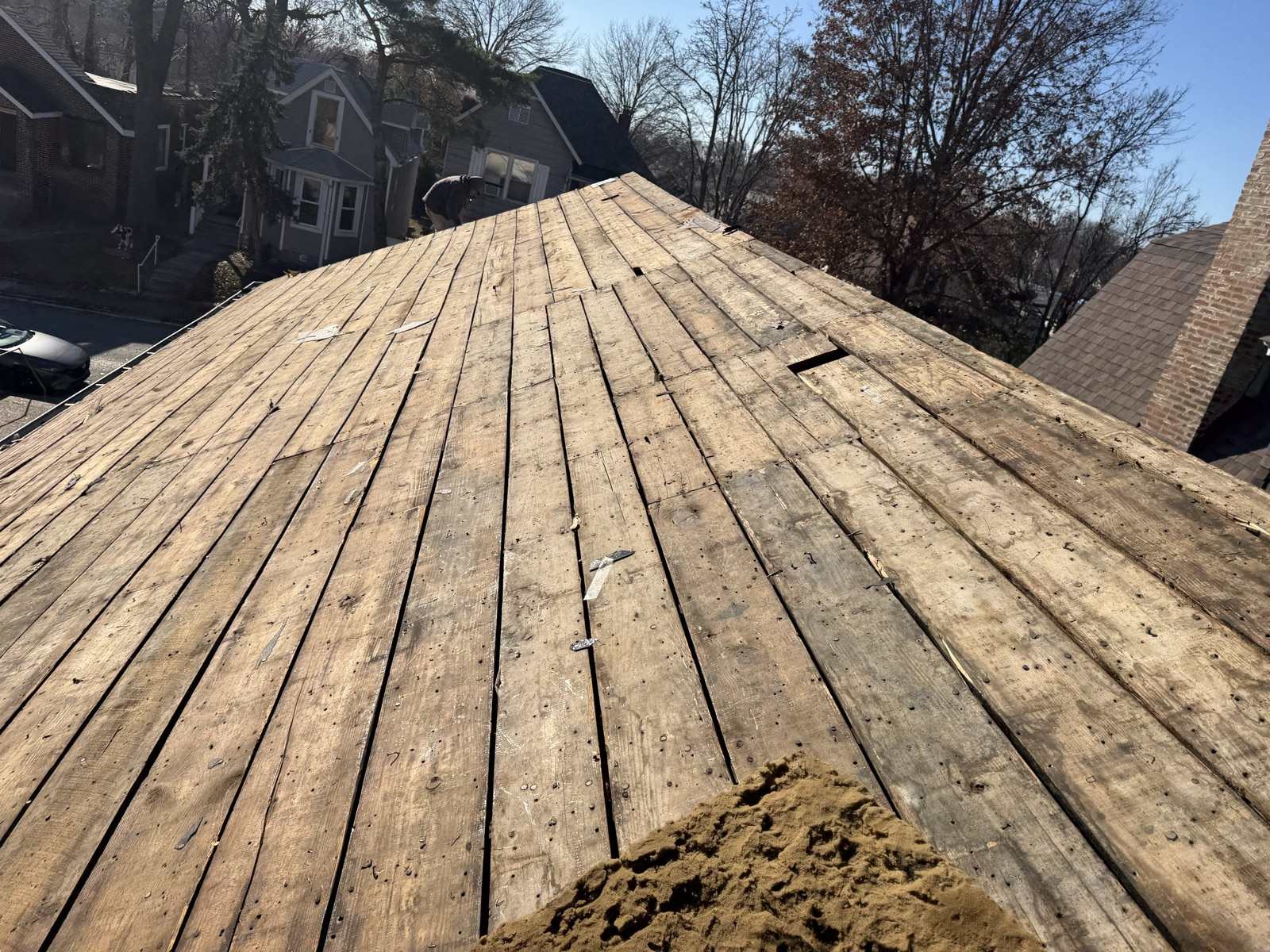
One layer and two layers are different jobs. Two layers is roughly double the tear off labour and roughly double the tonnage going into the dumpster, and disposal here is charged by weight. A roof that was covered over once already is also a roof whose decking has not been seen in a long time.
Ask: how many layers do you expect, and what happens to the price if there are more?What is under the shingles
The decking is the single most common reason a real number moves after work has started, and it is genuinely unknowable in advance. A good estimate does not pretend otherwise. It states a unit price for replacement sheathing in writing before the tear off begins, so the figure is agreed while you still have a choice about it.
Ask: what is the per sheet price, and will you photograph the bad boards?Penetrations and detail work
Chimneys, skylights, dormers, valleys, sidewalls, vents and pipe collars. Every one of them is a hole in the roof that has to be made watertight by hand, every one takes time that the open field does not, and every one is where the next leak will start if it is done badly. The count belongs on the estimate as a count.
Ask: how many penetrations, and is new flashing included at each one?Material
Three tab and architectural shingles are different weights, different coverage and different labour. Impact resistant material costs more again. Keys installs Atlas and Malarkey and nothing else, which at least means a quote from here is comparing two lines from the same shelf rather than two brochures.
Ask: which exact shingle, and what underlayment and ice barrier go under it?Access, disposal and who is actually on the roof
Where the dumpster sits, how far bundles have to be carried, whether the truck can reach the eave, what the tip charges by the ton, and whether the people on your roof are employees of the company you signed with or a crew subcontracted that morning. None of this is visible in a price, and all of it is in one.
Ask: whose crew is it, and where does the dumpster go?
What a quote that has not seen the roof is worth
Very little, and the reason is arithmetic rather than suspicion. Of the seven variables above, exactly one, roof area, can be estimated from aerial imagery with any confidence. Pitch is approximated. Layer count is invisible. Decking condition is invisible. Penetration flashing condition is invisible. Access is invisible. So a number produced from a screen has guessed five of seven inputs and rounded the guess in whichever direction its business model prefers.
The two directions are both familiar. A number guessed low buys an appointment and then grows, and it grows at the worst possible moment, which is the afternoon of day one with your roof open and a crew standing on it. A number guessed high protects the company against everything it could not see, and you pay a premium for the fact that nobody looked.
The one figure that should be on the page before the work starts
Not the total. The unit price for replacement decking. It is the line that moves most often, it moves while your negotiating position is at its weakest, and it is the easiest thing in the world to agree in advance. An estimate that names it has told you the truth about what it does not know. An estimate that is silent about it is not cheaper, it is simply silent, and silence gets priced on the day.
Where to go from here
Start with the unit
A square is not a square foot
What the trade actually counts, why waste is a real line and not a padding line, and how to check a square count against your own house.
Read the unitThe multiplier
Pitch, and the 7:12 line
A table of exact slope multipliers, where the walkable threshold sits, and why the same footprint can carry forty percent more roof.
Read the tableThe unknowable line
The decking line
Why the number moves on the first morning, what a per sheet price looks like written down, and the county rule that a quarter of the deck triggers.
Read the surpriseTwo quotes, two numbers
Why published costs disagree
How a factor of four appears between sources that are all telling the truth, and what a lead capture calculator is actually measuring.
Read the averagesOn paper
Reading an estimate
The lines a real roofing estimate contains, in the order they should appear, and the four that are usually missing.
Read the documentExpires October 2026
The Missouri tax credit
RSMo 135.445 gives a credit equal to a homestead insurance deductible incurred in 2025, capped at five thousand dollars. It ends.
Read the statuteFree, about an hour, in writing
We are on your roof with a tape and a camera this week
Send the address tonight and Keys books the takeoff. Somebody climbs it, counts the planes, measures the slope on each one, reads the layer count at the rake, counts the penetrations, photographs the lot and writes the per sheet decking rate on the document. You keep the file. No price is said until the roof has been measured, and nothing is signed on the day.
If it is quicker to talk, this is the office line and not a call centre.
(314) 220-2333Keys Roofing, greater St. Louis